Presentation CANVASES THROUGH TIME GOLD IN ART CREATIVE GEOMETRY ARCHITECTURE Design HISTORY Contact & Information
English Français

CREATIVE GEOMETRY

Upon returning to Switzerland, Ali Adeli decides to fully dedicate himself to art, abandoning architecture. He opens a gallery in Fribourg to exhibit his works and set up a studio. At the inauguration, he presents his oil paintings created during his wife's pregnancy, as well as works from the limited edition Homme & Femme, created with gold leaf.

Before embarking on a deeper exploration of geometry, Ali creates, as an experiment, his first geometric painting, using silver leaf to adopt a more contemporary style. This painting catches the attention of his first client, an architect, who buys it among the other works on display.

This first sale becomes a decisive moment, motivating the artist to deepen his exploration of geometry.

Fascinated by the interplay of shapes and perspectives, and inspired by his admiration for Victor Vasarely, the pioneer of Op Art, Ali seeks to push the boundaries of geometry and visual perception.

With this goal in mind, he continues his exploration by creating a plaster bas-relief, sculpted on a fabric-covered support, where he incorporates interwoven geometric shapes.

At the center of the artwork, a cube in perspective becomes the starting point for a deeper study of three-dimensional geometry. The cube’s distorted facets, influenced by the angle of view, become the key element that will guide his future work, paving the way for his Adeli Création series.

This bas-relief marks a major turning point in his artistic journey and inaugurates a new line of creation that explores geometry in an innovative way.

This return to art also marks the beginning of a new creative phase, nourished by his years of study at the School of Decorative Arts and his immersion in architecture.

Building on this inspiration, he developed a series of paintings incorporating perspective effects based on cubes and three-dimensional shapes, creating compositions where depth and structure were ever-present.

Each piece was designed so that the shape of the painting itself became an integral part of the geometric composition, eliminating the need for a traditional frame.

The artist ordered custom MDF wood panels from local carpenters and carefully prepared them, much like a vehicle receiving its base coat before applying the paint.

He then applied layers of lacquer in various colors as a second step, after carefully preparing the graphic composition in the form of a sketch.

This lacquer work, executed with great precision, gives each painting a subtle shine, making each piece an extension of the space’s architecture. The shape of the artwork thus becomes dynamic, changing depending on the angle at which it is placed against the wall, offering a different perception with each observation.

"Collection of Geometries" Nos: 2012, 2010, 2011, 2013
Private Collection
Adeli Family
Montreux, Switzerland

The originality of Ali Adeli’s paintings lies in their ability to captivate the eye while blurring the boundaries between art and architecture. He managed to create an immersive visual experience where form, color, and texture intertwine to produce an illusion of depth, movement, and volume.

His series of geometric paintings, a true homage to the precision of architecture and the fluidity of abstract art, embodies the perfect harmony between technique and creative expression.

"Collection of Geometries" Nos: 2036, 2027, 2041, 2029
Family Adeli Collection
Montreux - Switzerland

"Collection of Geometries" Nos: 2019, 2020
Private Collection
Zug - Switzerland

"Collection of Geometries" Nos: 2026, 1305, 1306, 2017
Family Adeli Collection
Montreux - Switzerland

"Collection of Geometries" Nos: 2016, 2023
Private Collection + Family Adeli

"Collection of Geometries" Nos: 1304, 2008, 2009, 2007
Private Collection + Family Adeli
Montreux - Switzerland

"Collection of Geometries" Nos: 2039, 2028, 2043, 2040
Private Collection
Switzerland

"Collection of Geometries" The Small Rectangular One
Family Adeli Collection
Montreux - Switzerland

Beyond individual works, Ali Adeli had the idea of a transferable concept. His line, with its geometric shapes and play of perspectives, could be applied to any decorative object. Whether it was mirrors, tables, light fixtures, or other everyday items, he saw every surface as an opportunity to integrate his unique visual language. He didn’t limit himself to creating paintings; he aimed to redefine interior spaces by enriching them with his works, thereby giving an artistic dimension to functional objects.

Each piece, whether decorative or functional, had to carry his visual signature, instantly recognizable at first glance, so that people could say, “That’s Adeli.” This desire to create a distinctive and immediately recognizable artistic style reflected his ambition to merge art and design in an indelible way.


What marked a new maturity in his previous artistic influences and interior architecture experiences was that he no longer limited himself to designing isolated decorative objects but aimed to integrate these pieces into a cohesive whole, where every element of the room, whether functional or decorative, would be in harmony with the others.

This holistic approach demonstrates a deep understanding of space, where art and architecture meet and merge to create a visually and sensorially enriching experience.
Thus, Ali Adeli succeeded in breathing new life into everyday objects by giving them both an aesthetic and conceptual dimension, while continuing to develop his own geometric language.

These decorative and functional objects, now bearing his artistic mark, became both design elements and works of art in their own right, where architecture and art blended to offer a total experience, within a contemporary and timeless vision.

EXPOSITIONS

In the meantime, Ali Adeli participated in several exhibitions throughout Switzerland to showcase his collection and introduce his geometric universe.

These events provided him with the opportunity not only to expose his work to a wide audience but also to attract private clients, who came to acquire his unique pieces, with each work becoming a distinctive and valuable element in interior design. Even more so, these exhibitions caught the attention of industrialists. Enchanted by the uniqueness of his approach and the originality of his creations, several companies began to consider his services for larger projects.

"Collection of Geometric" - Salon Suisse du meuble Exhibition
1989
Bern - Switzerland

"Collection of Geometric" - Ligam Exhibition
1991
Bern - Switzerland

"Collection of Geometric" - Showcase of Credit Suisse Bank
1991
Fribourg - Switzerland

GEOMETRIC ART SERVING INDUSTRY

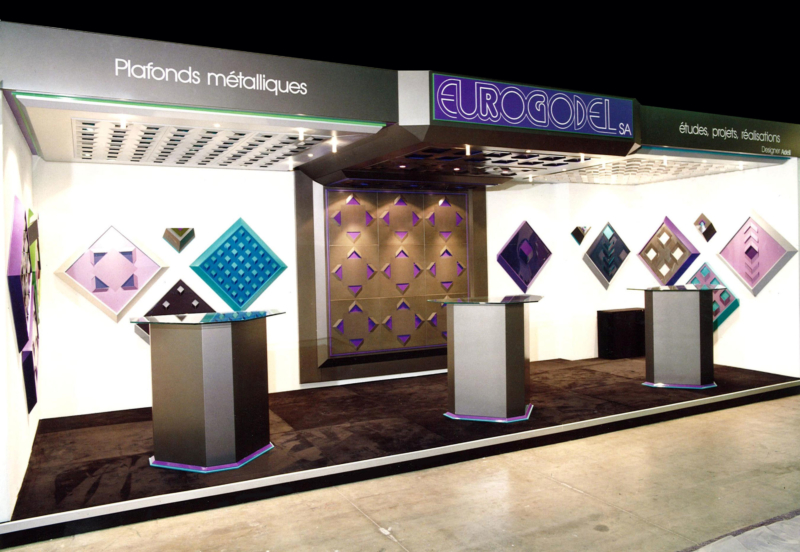
Industrialists from the region, particularly in the architectural field, turned to him to design innovative pieces in the same vein as his geometric works, including metal ceilings, wall panels, and metal cabinets, which could be integrated into office spaces.

Other architects also had the opportunity to select his works to incorporate them into their projects.

Design of the Eurogodel Stand at Batimat Exhibition
1992
Paris - France

Design of Metal False Ceilings for Godel Plafonds
1991
Domdidier - Switzerland

Exhibition Space Design for Godel Ceilings
1991
Domdidier, Switzerland

He also designed bathroom concepts for the renowned brand Franke, known for its expertise in kitchen and bathroom equipment.

Combining functionality with visual beauty, he added his distinctive touch to their designs by incorporating his geometric aesthetic into the space layouts. These collaborations allowed the artist to elevate his art beyond mere decorative work, introducing it into large-scale projects where architecture, industrial design, and art seamlessly came together.

This shift towards industry only expanded Ali Adeli’s horizons, as he successfully made his artistic language engage with the technical and aesthetic demands of the design world.

Each project, whether for an individual or a major brand, bore the imprint of a universe where art blended with architecture and design, thus establishing a unique and recognizable signature.